|
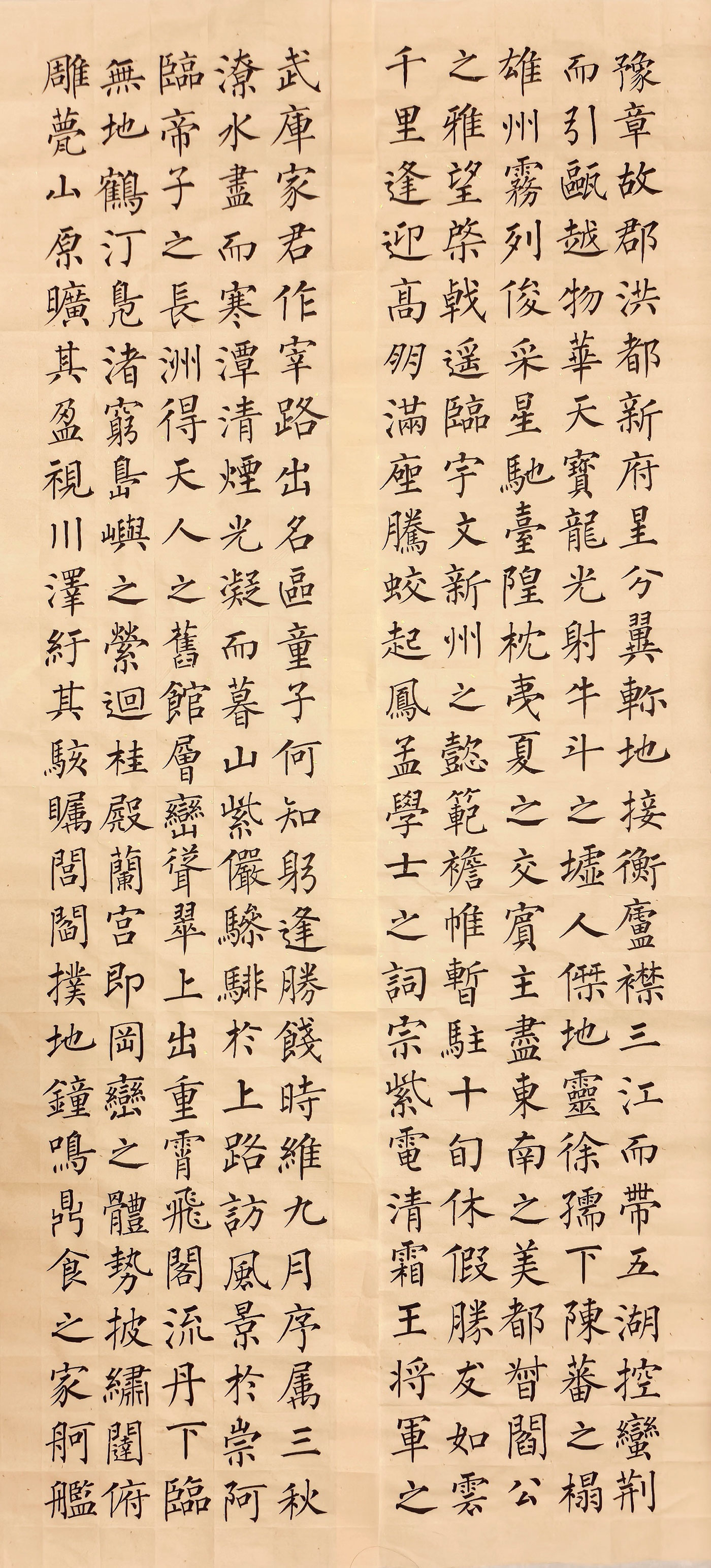
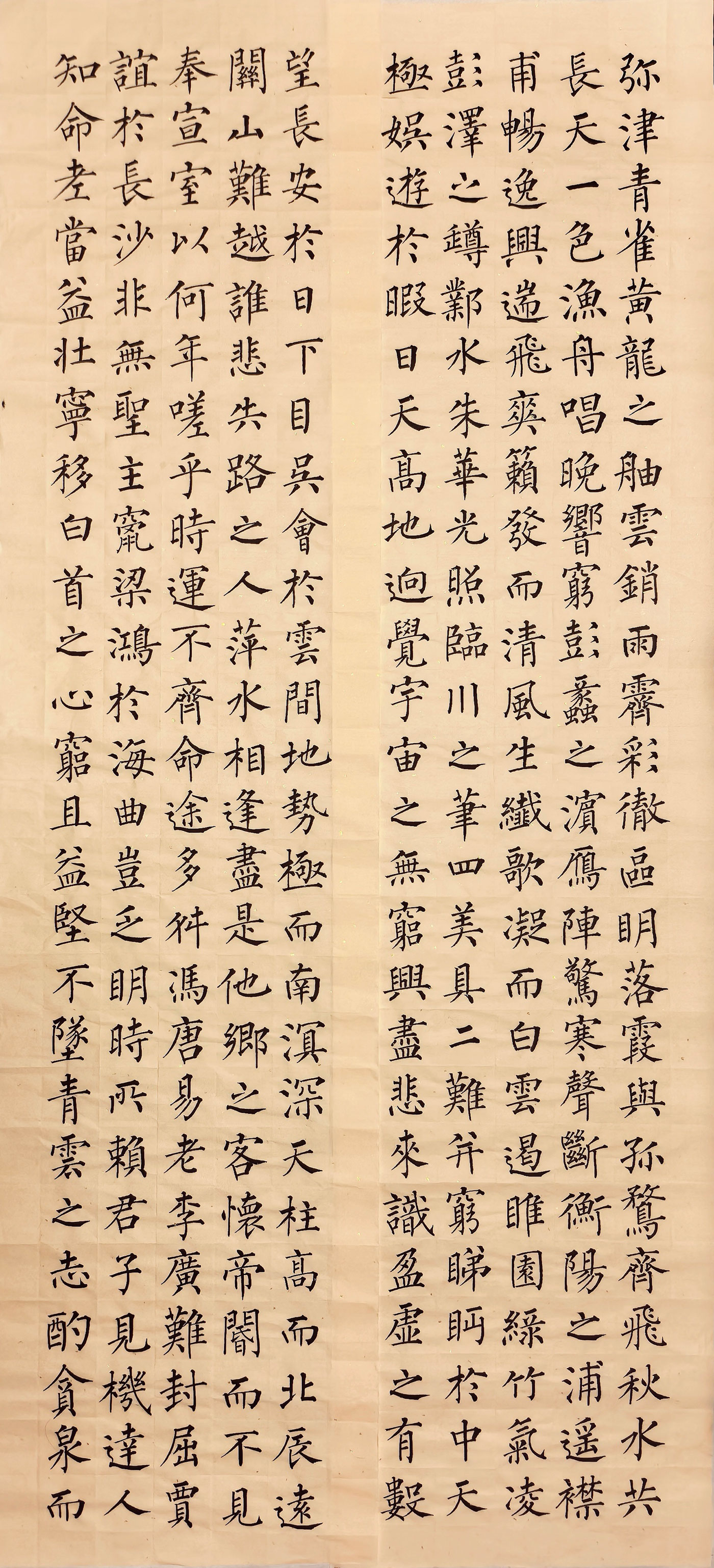
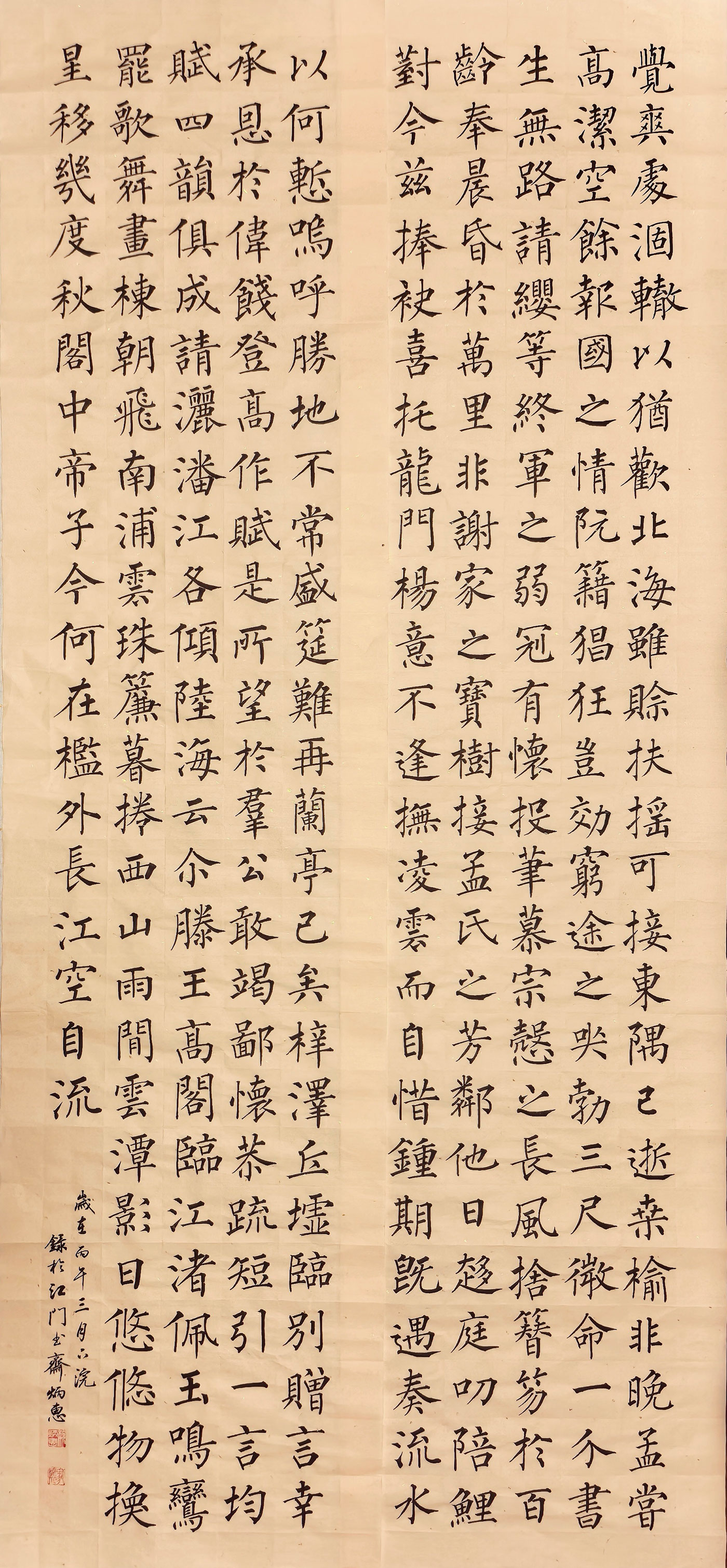
Under the brilliant canopy of the Tang Dynasty, two giants shone with peerless luster: Wang Bo, the prodigy whose "Preface to the Prince of Teng's Pavilion" stunned the prefecture of Hongdu, and Liu Gongquan, the grandmaster who immortalized the "Liu Style" (Liu Ti) through his principle of "uprightness in the heart for uprightness in the brush." When the transcendent literary genius of Wang Bo meets the resolute "bones" of Liu’s calligraphy, what kind of artistic sparks are ignited? Recently, Mr. Wei Binghui, Chairman of the Liu Gongquan Calligraphy Academy, unveiled his monumental long-form work—the Preface to the Prince of Teng's Pavilion written in Liu-style regular script (Kaishu). This is not merely a dialogue across a millennium between literature and ink; it is a profound baptism of the eyes and the soul.
I. Lean and Vigorous: The True Essence of "Liu Bones" In the world of Chinese calligraphy, there is a legendary saying: "Yan's muscles and Liu's bones." The Liu style is notoriously difficult to master because it must be "lean yet muscular, firm yet full of life." Observing Mr. Wei’s work, one sees brushstrokes like lances and halberds—sharp, decisive, and governed by a rigorous internal law. Vigorous Bone Strength: Mr. Wei’s brushwork perfectly interprets the "Iron Strokes and Silver Hooks" characteristic of the Liu style. Every horizontal stroke is saturated with power, and every vertical stroke sits with the weight of a falling boulder. This "lean firmness" is not dryness; rather, it is a refinement that has shed all superficiality, echoing the clarity and loftiness of Wang Bo’s descriptions of "the islets of cranes and the banks of wild ducks." Crisp and Noble Details: The Liu style demands strokes that are as sharp as swords and as clean as blades. In this scroll, Mr. Wei demonstrates immense virtuosity in his handling of details—the transitions are crisp and the turns are agile, without a hint of hesitation. This noble, upright air perfectly matches the soaring ambition of the young genius who penned the original text. II. Rigorous Composition: Constructing "The Pavilion" in Every Character Liu Gongquan’s calligraphy is famous for its structure: "tightly gathered at the center, radiating toward the four corners." In his creation, Mr. Wei has pushed this spatial aesthetic to its pinnacle. The text of the Preface is lush and dense with imagery. Mr. Wei treats every character like a miniature architectural marvel—lofty in its center of gravity, restrained internally yet expansive externally. This sense of structure gives the work an upward tension, as if the characters themselves are taking flight alongside Wang Bo’s "solitary duck and the autumn sunset." His layout is dense yet the flow of "Qi" (energy) remains uninterrupted, showcasing his mastery over grand-scale narrative.
III. Unity of Text and Ink: Continuing the Spirit of the High Tang Calligraphy is more than technique; it is a manifestation of the soul. As the leader of the Liu Gongquan Calligraphy Academy, Mr. Wei has spent decades delving into the quintessence of Liu’s art. His work carries an innate sense of "Grand Uprightness" (Zhengda Qixiang). While the Preface reflects on the "vicissitudes of fate," its underlying tone remains one of soaring ambition. Mr. Wei’s calligraphy is dignified and austere, capturing not only the splendor of the Tang Dynasty but also the unyielding pride and perseverance of the traditional scholar. Between the lines, we read more than just the scenery of "autumn water and the long sky being of one color." We feel the tenacious vitality of the famous lines: "Old age should be even more vigorous... Poverty makes one even more determined, never losing the ambition to reach the blue clouds." This "upright spirit" at the tip of the brush is the most precious core of contemporary calligraphy art. IV. Heritage and Stewardship: The Responsibility of the Ink Mr. Wei Binghui’s transcription of this classic is more than a personal artistic expression; it is a soulful look back at a traditional masterpiece. In today’s fast-paced world, the ability to settle one’s heart and write a thousand-word scroll in rigorous regular script is a form of spiritual cultivation in itself.
In this Liu-style masterpiece, the lines contain "bone," and the structure reflects "character." It reminds us that immortal words can only achieve true eternity when paired with immortal ink. Conclusion: This masterpiece by Mr. Wei Binghui is a brilliant modern revival of the Liu aesthetic. Like a cup of pure tea, it cleanses the soul of worldly dust; like a sharp sword, it pierces straight to the heart. For those who love Chinese calligraphy and seek the long-lost "firm and noble spirit" of the ancients, this Preface to the Prince of Teng's Pavilion is a treasure to be savored and revered. |